
How to Start Drawing When You Have No Drawing Skills
A little secret: you don’t have to be good at drawing to enjoy it.
Somewhere between childhood and adulthood, many of us stopped drawing. Not because we stopped enjoying it, but because we started believing we weren’t particularly good at it. Suddenly, drawing became something reserved for artists. For people with sketchbooks full of beautiful illustrations. For those who could casually draw a perfect little café on the corner of a notebook.
And the rest of us?
We decided we simply weren’t creative. But here’s the thing: creativity isn’t something you have to earn by being good at it.
Sometimes, the best reason to pick up a pen is simply because you enjoy what happens when you do. If you’ve been wondering how to start drawing as a beginner, consider this your invitation. No pressure. No expectations. And absolutely no need to produce a masterpiece.
Why is starting to draw so intimidating?
For many beginners, the hardest part of drawing isn’t holding the pen.
It’s facing the blank page.
Where do you begin? What should you draw? What if it doesn’t look anything like you imagined? These questions can turn a potentially relaxing hobby into another activity where you feel the need to perform. But drawing doesn’t have to start with a blank sheet of paper. In fact, one of the easiest ways to begin exploring line work is to follow an existing illustration.
Can you learn to draw by tracing?
Tracing is a simple technique in which you follow the lines of an existing image. It’s accessible, beginner-friendly and particularly enjoyable if you’re interested in architecture, illustration or detailed line work.
Tracing can help you become more comfortable with:
- Holding and controlling a drawing pen.
- Following different line directions.
- Noticing shapes, proportions and small details.
- Working slowly and deliberately.
- Building confidence through repetition.
Of course, tracing isn’t the same as learning to draw independently from observation or imagination. But it can be a wonderful introduction to the experience of making art. And sometimes, enjoying the process is exactly what encourages you to explore further.
The beauty of fineliner drawing
There’s something particularly satisfying about drawing with a fineliner. No mixing colours. No waiting for paint to dry. No elaborate setup. Just a pen, a piece of paper and a little time.
Fineliners are especially popular for architectural illustrations because they allow you to work with precise lines and small details. Think beautiful European façades, charming windows, rooftops and elegant city streets. The kind of details you might usually walk past without noticing. When you spend time following these shapes, you begin to appreciate just how much character can exist in a single line.

Five tips for starting a drawing hobby
1. Start with something you genuinely love
Forget what you think you should be drawing. If you love architecture, start with buildings. If you’re obsessed with flowers, explore botanical illustrations. If travel inspires you, choose scenes that remind you of your favourite cities. A subject you enjoy makes it much easier to return to your hobby.
2. Choose simple materials
You don’t need an expensive collection of art supplies. A good-quality fineliner and suitable paper are enough to begin exploring line drawing. Keeping your materials simple also makes it easier to start whenever you have a spare moment.
3. Remove the pressure of the blank page
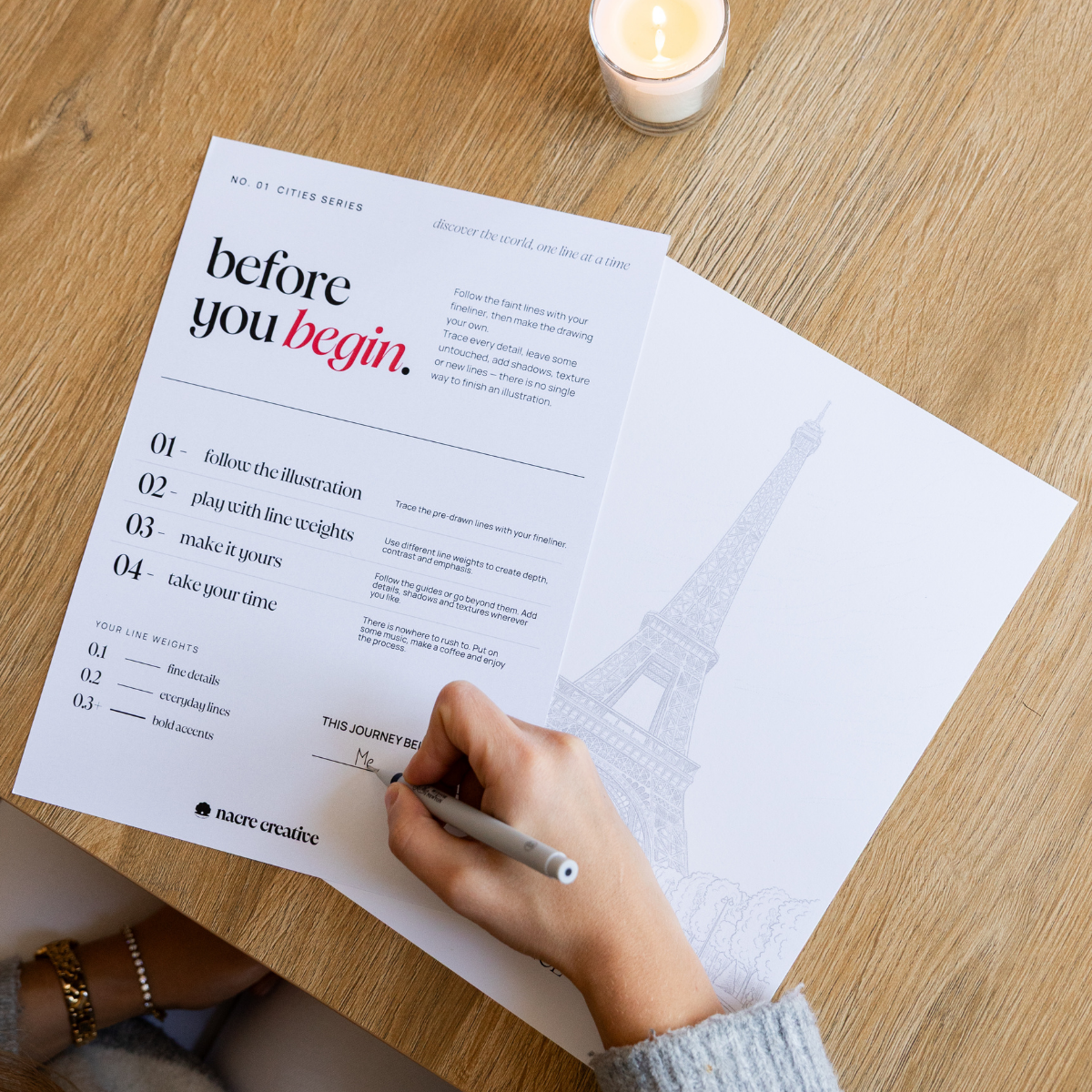
If drawing from scratch feels intimidating, begin with a pre-printed illustration. Following existing lines lets you focus on the movement of your hand and the pleasure of creating something visually beautiful. There’s no need to decide what to draw or worry about getting the proportions right.
4. Make it a screen-free ritual
Instead of reaching for your phone the next time you have twenty minutes to yourself, try picking up a pen. Put on some music, make a coffee and give yourself permission to focus on one simple activity. You don’t need to finish an entire illustration in one sitting. The point is to enjoy the time you spend making it.
5. Let go of perfection
Your lines might not always be perfectly straight. You might occasionally go outside an outline.That’s fine. A creative hobby doesn’t need to become another thing you’re trying to master. Sometimes, a slightly imperfect drawing is simply proof that a real person made it.
Meet Line by Line – No. 01: Cities
At Nacre Creative, we wanted to create something for people who love beautiful illustrations but don’t necessarily consider themselves artists. Something that makes it easy to sit down, pick up a pen and start creating.
That’s how Line by Line – No. 01: Cities came to life.
A fineliner workbook featuring nine pre-printed architectural illustrations inspired by some of the world’s most beautiful cities. Inside, you’ll find detailed city illustrations ready for you to trace, line by line. The workbook also includes a Winsor & Newton 0.5 mm fineliner, so you can begin creating without searching for the right pen.
There’s no need to sketch an entire building from scratch. No need to work out complicated perspectives. And no need to know how to draw before you begin. Simply follow the lines and enjoy watching each illustration come to life. No blank page. No pressure. No drawing skills needed.

Why architectural drawing?
Architecture has a way of capturing the personality of a place. A particular window. An ornate doorway. A row of rooftops. These are the little details that make cities memorable. With architectural line drawing, you get to spend time noticing them. It’s a little like travelling through your favourite cities, one illustration at a time. And because the illustrations are already printed, you can focus entirely on the satisfying process of tracing each detail.

A creative hobby that fits into real life
One of the best things about fineliner drawing is how little preparation it requires. You don’t need a dedicated art studio or an entire afternoon. You can bring your workbook to a café, take it on a weekend away or enjoy it at home on a quiet evening. It’s also a lovely activity to share with someone. Think creative coffee dates, slow Sunday mornings or a screen-free evening with a friend.
The kind of plans that don’t require much organising but leave you feeling like you’ve spent your time doing something meaningful.

You don’t need to become an artist to make art
Perhaps the most important thing to remember is that your hobbies don’t have to be impressive. You don’t need to monetise them, master them or share the results online. You’re allowed to do something simply because you enjoy it. And if tracing a beautiful city illustration with a fineliner makes your afternoon a little better? That’s reason enough.
Discover Line by Line – No. 01: Cities by Nacre Creative, and find out how satisfying it can be to create something beautiful, one line at a time.

Prefer playing with colours? Discover our 2027 Watercolour Calendar Workbook, designed to bring a little creativity, colour and calm into every month of the year.
